

Reminding Your Adult Child Without Making Them Feel Like a Child | Chaos to Calm
The Reminders Nobody Sees Me Give
By Sami Ward | Chaos to Calm | 10 August 2026
There's a job I do every single day that nobody knows about. It isn't written down anywhere. It doesn't have a name. And if I tried to explain it to someone whose life hadn't been shaped by this, I don't think they'd understand why it takes so much out of me. Because on the surface, it looks like nothing at all. It looks like a mum mentioning, ever so casually, that there's an appointment on today. It looks like a passing word about the new medication. It looks like the smallest, most ordinary thing in the world.
But it isn't. It's a tightrope. And I walk it several times a day.
She isn't forgetting because she doesn't care
The first thing I had to understand, really understand, deep down, is why my young adult forgets the things she forgets. Because for the longest time, a little voice in me wanted to make it mean something. Why can't she just remember? Why do I have to hold it all?
But here's the truth. She doesn't forget because she doesn't care. She forgets because her brain is already full to the brim. It's carrying the anxiety that never switches off, the physical pain she manages quietly, the racing thoughts, the enormous daily effort of simply getting through. And when a mind is that full, the ordinary details, the appointment, the tablets, the help sitting right there for her to use, they slip straight through the gaps.
So I've become the second brain. I hold the threads so that nothing important gets dropped. And most of the time, nobody sees me do it at all.
Every reminder is a tightrope, and here's why
You'd think the answer would be simple. Just remind her. Just say, "Have you taken your tablets?" or "Don't forget you've got that today." And with most people, it would be simple.
But with our young people, every reminder carries a risk. And the risk is that she doesn't hear it as help. She hears it as proof. Proof that she can't cope. Proof that she's failing. Proof that she's still a child who needs managing. And that is the very last thing she wants to feel, because more than almost anything, she wants to be independent. She is fighting for it. She wants to stand on her own two feet and run her own life like everyone else her age.
She just also needs me standing quietly behind her, ready to catch her if she wobbles. Independent, but with mum as backup. And that is a delicate, delicate thing to hold, because the way I word one small sentence can be the difference between her feeling supported and her feeling small.
Why forgetting feels like failing to her
If you've ever offered a gentle reminder and watched it land badly, watched her face fall, or snap, or go quiet, please hear me when I say it is not because you did it wrong. It's because you were touching something incredibly tender.
For our young people, forgetting isn't neutral. Forgetting feels like failing. And when we point, even lovingly, at the thing that's been forgotten, we can accidentally press right on the bruise, the part of them that already believes they're not capable enough, not good enough, too much, too broken. So the sharpness that sometimes comes back, the irritation, the "I know, mum", that isn't really about us. That's her defending the fragile scrap of independence she's working so hard to build. Once I understood that, I stopped taking the prickliness personally, and I started being far gentler and far cleverer about how I hold her up.
The small changes that softened everything
I want to share the handful of things that have genuinely helped me, not as rules, but simply as things that took some of the sting out of it.
The first is that I try to remind her of the thing, not of her. Instead of "have you remembered," which shines a spotlight on what she might have failed to do, I mention it almost in passing. "Oh, that's on today, isn't it?" Light. Shared. As though we're two adults keeping track of a busy week together, rather than me checking up on her.
The second is that I try to offer rather than instruct. "Do you want me to be your reminder for that one?" hands her the choice. It turns me into a tool she gets to use, not a parent doing something to her. And there is a whole world of difference between "let me manage this for you" and "I'm right here if you'd like backup."
And the third, which is the one that matters most, is that I let her keep her dignity even when I'm the one holding all the information. Because the goal was never for me to be right. It was never "see, I remembered and you didn't." The goal is simply that the important thing gets done, and she still feels like a capable adult at the end of it. If both of those things happen, I've done my job. Nobody ever needs to know I was the safety net.
The part I don't say out loud
And now the honest bit. It's tiring. Being the second brain is exhausting. Holding all of it, the timings, the appointments, the medications, the details, while also holding her feelings about all of it, while also making absolutely sure she never once feels managed… that is an enormous amount of invisible work. And I'm doing it on top of everything else, on top of the worry that never truly switches off.
So if you're worn down by it too, if you feel like you're forever the one who has to remember, and if there's a flicker of resentment that you instantly feel guilty for, I want you to know that's real, and it's allowed, and it doesn't make you ungrateful or unkind. It makes you human. You are doing one of the hardest, most loving, least acknowledged jobs there is. You are being someone's memory while quietly protecting their pride. That is not nothing. That is love in its most patient form.
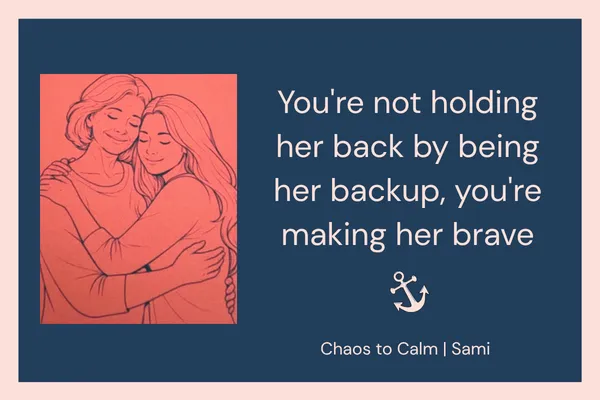
You're not holding her back, you're making her brave
So here is what I hold onto, on the days it feels heavy. I am not holding her back by being her backup. I am the very thing that makes her independence possible. The only reason she can reach for a bigger life is that she knows, underneath it all, that someone is holding the threads so nothing important falls. That isn't me keeping her a child. That's me making her brave enough to try.
And nobody sees me do it. But that's alright. Because I know. And now, so do you.
If you're the one who remembers everything so they don't have to, I'd love you to sit with this for a moment: what would it feel like to let yourself believe that your quiet, invisible reminding isn't holding your child back at all, but is the very thing making their independence possible?
Your calm in the chaos,
Sami 💙⚓
FAQ Section
Why does my adult child forget important things like appointments and medication?
For many young adults with emotional dysregulation, forgetting has very little to do with not caring and everything to do with a mind that is already carrying a great deal. Anxiety, physical pain, racing thoughts and the sheer daily effort of coping take up so much mental space that ordinary details slip through the gaps, which is why so many parents quietly become the memory their child relies on.
How can I remind my young adult of something without making them feel like a child?
The gentlest approach is to remind them of the thing rather than of themselves. Mentioning something in passing, such as saying that an appointment happens to be on today, feels shared and collaborative, whereas asking whether they have remembered can feel like being checked up on. The aim is to sound like two adults keeping track of a busy week together.
Why does my child react badly or snap when I remind them of something?
For young people who struggle with self-worth, forgetting can feel like failing, so a reminder can accidentally press on a very tender bruise. The irritation that comes back is usually not about you at all; it is them defending the fragile independence they are working hard to build. Understanding this makes it far easier not to take the reaction personally.
Is it wrong to keep reminding my adult child of things?
It is not wrong at all. Being someone's backup is not the same as holding them back. In fact, knowing that someone is quietly holding the threads so nothing important falls is often the very thing that gives a young adult the confidence to reach for more independence, not less.
How do I support my child's independence while still being there for them?
The balance many parents find helpful is to offer rather than instruct. Asking whether they would like you to be their reminder for something hands them the choice and turns you into a resource they get to use, rather than a parent doing something to them. It respects their wish to be independent while keeping the safety net firmly in place.
Why do I feel so exhausted by all the reminding and organising?
Because being a second brain is genuinely hard, invisible work. You are holding not only the practical details but also your child's feelings about those details, all while making sure they never feel managed, and you are doing it on top of a worry that rarely switches off. Feeling worn down by that does not make you ungrateful; it makes you human.
Is it normal to feel resentful about being the one who has to remember everything?
Yes, and it is far more common than most parents admit. A flicker of resentment, quickly followed by guilt, is a very human response to carrying a heavy, unacknowledged load. Naming it honestly, rather than judging yourself for it, is often the first step towards feeling a little lighter.