

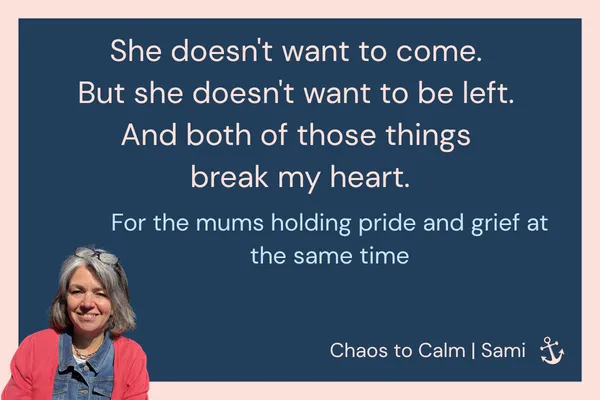
She Doesn't Want to Come. But She Doesn't Want to Be Left. And Both of Those Things Break My Heart.
She Doesn't Want to Come. But She Doesn't Want to Be Left. And Both of Those Things Break My Heart.
By Sami Ward | Chaos to Calm | 29th June 2026
There is a version of this that looks like progress.
And it is progress. I want to be really clear about that before I say anything else. When your young adult chooses not to come on a family holiday, not because they can't, but because they are building a life of their own, making their own choices, asserting their own independence, that is something to be proud of. And I am. Genuinely, fiercely proud.
But pride and grief are not opposites. They can live in the same chest at the same time. And anyone who tells you otherwise has never loved someone whose life has been shaped by trauma.
The Independence Is Real. So Is the Complicated Mess That Comes With It.
She doesn't want to come. That part is straightforward enough.
She is twenty-something, with her own relationships, her own routines, her own sense of what she needs. She doesn't want to be on a family holiday. And honestly, that is exactly as it should be.
But here is where it gets complicated.
She also doesn't want to be left. Not really. Somewhere underneath the independence, underneath the I'll be fine, there is a nervous system that has learned the hard way that people leaving can mean something much more frightening than a two week holiday. And so the leaving, however planned, however temporary, is different for her than it might be for someone else.
She holds both things at once. The wanting of her own life. And the fear of being without you in hers.
And you hold both things too. The pride. And the grief.
The Grief Isn't for What Was. It's for What Should Have Been.
I want to say something carefully here, because I think it matters.
The grief I carry around holidays isn't nostalgia. It isn't a longing to go back to when she was small and everything was simpler and she'd pack her own little bag and come along without a second thought.
It's something different. Something harder to name.
It's the grief of knowing that her life has been shaped by things that shouldn't have happened to her. That the reason holidays are complicated isn't that she's grown up, it's because growing up was harder for her than it should have been. That the version of her life that exists is not the version she deserved.
That is a particular kind of grief. Not for the past. For the life that should have been possible. For the version of her twenties that trauma took away before she ever had a chance to live it.
And that grief doesn't go away just because she is doing well. Just because there is progress. Just because you are proud.
What Nobody Sees When You Book the Holiday
There is a whole invisible process that happens before we ever get to the airport.
The conversations. The timing. The checking in. The quiet monitoring of where she is emotionally, whether now is a good time, whether everything that needs to be in place actually is. The guilt that sits in your stomach when you finally press confirm on a booking. The mental rehearsal of every possible thing that could go wrong while you're away.
And then the holiday itself, which is wonderful, and which also carries a layer of something else underneath it. An awareness. A thread of connection you maintain across the distance. A part of you that never fully switches off.
That is not how other people book holidays. That is not how other people go on them.
And yet we do it anyway, because we also deserve to have good things. Because going is not the same as not caring. Because she would not want us to stop living either.
For the Mum Who Feels the Grief of a Different Life
If you are reading this and you know this feeling, not the sadness of your child growing up, but the grief of what their life should have looked like, the anger sometimes, the huge ache of knowing that things were harder for them than they should have been, I want you to know that feeling is valid.
You are allowed to grieve that, even while you celebrate how far she has come. You are allowed to hold the pride and the heartbreak in the same hands without one cancelling out the other.
Her independence is real, and it is earned, and it is something. It really is.
And the life she should have had matters too. Your grief for that is not self pity. It is love. It is the clearest possible sign that you know what she deserved, and you wish with everything you have that she'd been able to have it.
That is not a small thing. That is the whole thing.
Something to sit with this week: when you feel that grief for the life your child should have had, do you allow yourself to feel it, or do you push it down because it feels disloyal to the progress they've made?
Your calm in the chaos,
Sami 💙⚓
Frequently Asked Questions
Why do I feel grief when my young adult chooses not to come on holiday if they are doing well?
Because the grief isn't really about the holiday. It's about what the holiday represents, a version of your child's life that should have been more straightforward, more carefree, more possible. Pride in their independence and grief for what they should have had are not contradictions. They are two entirely honest responses to a complicated situation, and both deserve to be acknowledged.
Is it normal to grieve the life your child should have had even when they are making progress?
Completely normal, and more common than you might think. Progress doesn't erase the awareness of what was lost or what was harder than it should have been. Many parents find that progress can actually bring grief closer to the surface, because there is finally enough breathing space to feel it. It doesn't mean you aren't grateful. It means you love them and you know what they deserve.
Why does my young adult say they don't want to come on holiday but then struggle when we go?
This is the heart of the holiday paradox for young adults with emotional dysregulation. The desire for independence is real and genuine. So is the fear of being left. Both things can be true at the same time, and they don't cancel each other out. Their nervous system may have learned to associate people leaving with something much more frightening than a temporary absence, and that response doesn't simply switch off because the circumstances are different now.
How do I manage the guilt of going on holiday when my child is struggling?
Start by separating guilt from responsibility. Guilt tells you that going is wrong. But going on holiday is not the same as abandoning your child. Having a life, having rest, having joy, these are not acts of neglect. They are what keep you able to show up for your child in the long run. Guilt is a feeling, not a fact, and it deserves to be gently questioned rather than automatically obeyed.
How do I talk to my young adult about holidays without it becoming difficult?
Honesty and consistency tend to help most. Being clear about when you are going, when you are coming back, and what will be in place while you're away reduces the uncertainty that fear of abandonment feeds on. Keeping the conversation calm and matter of fact, rather than overly reassuring or apologetic, also helps. You are not doing something wrong by going. Your tone can reflect that.
What does it mean when a young adult says they are fine with you going, but then isn't?
It often means they genuinely believed they would be fine, or genuinely wanted to be fine, and their nervous system had other ideas. It is not necessarily dishonesty. It is the gap between what they think and what their body does when the moment actually arrives. That gap can be frustrating and heartbreaking to witness, but it is a very real feature of emotional dysregulation rather than a choice.
How do I hold grief and pride at the same time without one overwhelming the other?
You allow both to exist without demanding that they resolve into something simpler. Grief doesn't mean you aren't proud. Pride doesn't mean you aren't grieving. When you notice one feeling starting to crowd out the other, gently acknowledge the one being pushed aside. Both are true. Both matter. And permitting yourself to feel them fully, separately and together, is one of the most honest things you can do.