

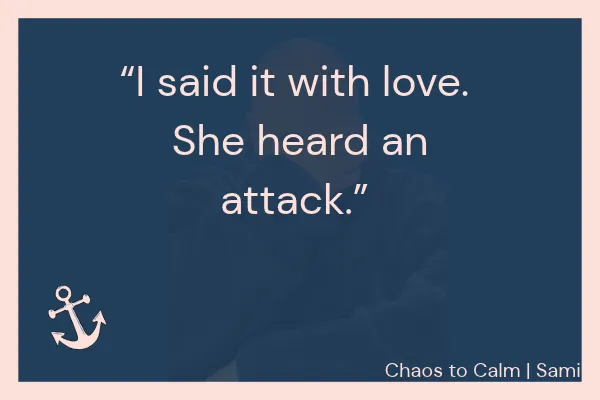
Why "I'm just worried about you" can land as an attack
You picked your moment. You waited until the house was quiet, until she seemed a bit softer, until the time felt right. You kept your voice gentle. "I'm just worried about you, love."
And somehow, those few soft words detonated.
Now she's shouting that you think she's useless. That you're always on at her. That nothing she does is ever good enough. And you're left standing there thinking: but I said I was worried. I said it kindly. How on earth did that become an attack?
If that's you, you're not doing it wrong. Something happened in the half second between your words leaving your mouth and landing in her ears, and once you can see it, it stops feeling like a mystery you keep failing.
You said love. She heard "you're failing."
Your words went in through a filter, and that filter turned them into something you never said.
For a young adult with emotional dysregulation, that filter has a name a lot of mums have never been told: rejection sensitivity. It means the brain is on constant high alert for any hint of criticism, disappointment or rejection, and it finds it almost everywhere, even inside a sentence that was pure love.
So "I'm worried about you" doesn't land as "I love you and I've noticed you're struggling." It gets filtered into "you think I'm failing, you've noticed I'm a mess, you're disappointed in me." And her body reacts to that version. The one she heard, not the one you said.
Why the same words hit so differently
When someone is already frightened that they're not enough, every scrap of attention gets scanned for proof. And here's the painful bit: care and criticism can look almost identical through that lens, because both of them say the same thing underneath. "I've been watching you."
For most of us, being watched by someone who loves us feels safe. For her, it can feel like being inspected and found wanting.
It isn't logic, and it's much faster than logic. By the time the thinking, reasoning part of her brain could step in and reassure her, the hurt has already hit and the shutters have already come down.
It's not you getting it wrong
If you take one thing from this, take this. The explosion is not proof that you said it badly, or that you're a bad mum. You could choose the kindest, most careful sentence in the world and it can still land as an attack, because the filter is doing the work, not your words.
That matters, because so many mums go quiet. They stop saying anything at all, terrified of setting her off. And then she feels abandoned, which is the very thing sitting underneath the whole condition. You don't have to go silent. You just get to say it a little differently.
Three kinder ways to say the worried thing
1. Lead with her, not your worry. Instead of "I'm worried about you," try "How are you doing in yourself at the moment?" Worry points at a problem in her. A gentle question points at her, the person. Same care, far less to defend against.
2. Say out loud that it's coming from love. Name your intention before the message. "Can I say something, and it's coming from love, not a telling off?" You're disarming the filter before it fires, telling her brain in advance which version to hear.
3. Offer presence, not a fix. Often she's not braced for your worry, she's braced for advice. Try "I'm not going to try and fix anything. I just wanted you to know I'm here." No solution, no inspection, nothing to push against. Just a hand held out.
One tiny thing to try this week
Next time the worry rises in you, pause before it comes out as "I'm worried about you." Swap it for one gentle question about her, and then stop talking. Let the silence be warm, not waiting. You might be surprised what climbs into it.
You don't have to get the words perfect
Loving a young adult who hears love as criticism is exhausting, and lonely, and you are doing it anyway. That is quietly extraordinary. You don't have to find the perfect sentence. You just have to keep the door open.
And if you'd like to be around mums who know exactly how that five word landmine feels, come and join my free community. Nobody there will tell you you're overreacting. 💙
Join the free Chaos to Calm community for mums
Your calm in the chaos, Sami 💙⚓
Frequently asked questions
What is rejection sensitivity?
It's a heightened, painful reaction to any perceived criticism, rejection or disappointment. It's common in emotional dysregulation, ADHD and EUPD/BPD, and it can make even loving words land as an attack.
Why does my daughter get angry when I show I care?
Often because care and criticism feel almost the same through a rejection-sensitive filter. Both say "I've been watching you," and when someone fears they're not enough, being watched can feel like being judged.
How can I talk to my young adult without upsetting them?
Lead with a gentle question about them rather than your worry, say out loud that it's coming from love, and offer presence instead of advice. And remember: an upset reaction isn't proof you did it wrong.
Get The Calm Catch Up 💙
A gentle, honest email most Fridays, for mums walking alongside a young adult with emotional dysregulation. Pop your details in below and I'll land softly in your inbox.