Letting Your Adult Daughter Make Her Own Decisions After Inpatient | Chaos to Calm
Letting Her Go
She came out of inpatient on Wednesday.
And the following Friday, she’s going away for a week with her girlfriend.
Both holidays were booked about six months ago.
Back when hospital wasn’t part of the picture.
Back when we were just living life and planning ahead like any other family.
At the same time she booked hers, we booked ours, Wednesday to Thursday, so we’d be away during part of that week too.
No hidden strategy.
No crisis planning.
Just normal life.
And then everything changed.
Admission.
Risk assessments.
Inpatient.
Survival mode.
But the bookings stayed.
And now here we are.
Discharged on Wednesday.
Trip on Friday.
And people ask me:
“Are you going to let her go?”
Let.
That word lands heavily when you’ve spent weeks fighting to keep your child safe.
The Fear Behind the Question
I understand why people ask.
They’re thinking about risk.
They’re thinking about how recent inpatient was.
They’re thinking, “Is this wise?”
But what they don’t see is this:
If we cancel every plan every time there is a crisis, we unintentionally teach fragility.
We teach:
Life stops when you wobble.
You can’t cope.
The world isn’t safe enough for you.
Recovery doesn’t happen inside four walls.
It happens in ordinary life.
And ordinary life sometimes includes going away with your partner.
She Is an Adult
This is the part that is uncomfortable for many people.
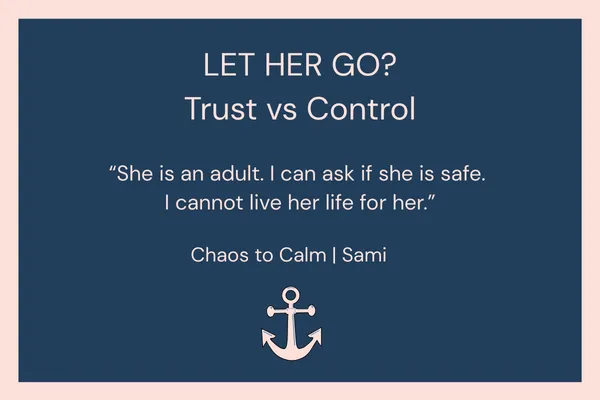
She is an adult.
Not a child I can ground.
Not a teenager I can forbid.
An adult.
That doesn’t mean there’s no risk.
It doesn’t mean I don’t worry.
It doesn’t mean I haven’t run through every scenario in my head at 3am.
It means the relationship has shifted.
I can ask:
“Are you safe?”
“Do you have a plan if you feel overwhelmed?”
“Will you message me if you need me?”
I can look her in the eye.
And when she says, “Yes, I’m safe.”
I have to decide whether I trust that.
Trust Is Not the Same as Blind Hope
Trust doesn’t mean I switch off concern.
It means I choose not to control what I cannot ultimately control.
Hypervigilance gives the illusion of safety.
But it doesn’t actually prevent everything.
It just exhausts us.
If I hold too tight, I become part of the cage.
And I don’t want to be her cage.
I want to be her anchor⚓
There’s a difference.
The Hardest Shift
There is a brutal transition that happens when your child has been very unwell.
You move from:
“I must keep her alive.”
To:
“She is learning to keep herself safe.”
That shift feels dangerous.
But staying permanently in crisis mode is not sustainable, for her or for me.
Part of recovery is returning to normal decisions.
Part of recovery is not wrapping someone in permanent restriction.
Part of recovery is dignity.
Even when my stomach flips.
Even when I watch her pack and feel that all too familiar rush of fear.
To the Mum Reading This
If people are asking you,
“Are you going to let them?”
And your child is an adult…
Pause.
Ask yourself gently:
Is this about actual, present risk?
Or is this about my anxiety remembering the past?
Those are not the same thing.
You can check in.
You can safety plan.
You can ask the hard questions.
And sometime, after you’ve done all of that, you have to breathe and allow them to live.
Not because it’s easy.
But because control is not the same thing as protection.
And raising an adult with emotional dysregulation means slowly, painfully, learning where your responsibility ends… and theirs begins.
That doesn’t make you careless.
It makes you brave.
If you’d like, we can now:
⚓ Trust vs Control - A Gentle Reflection
If you’re in this space right now, take a quiet minute and ask yourself:
What is the actual, present risk?
(Not the past. Not the worst-case scenario. Just right now.)Have I asked the safety questions?
– Are you safe?
– Do you have a plan?
– Who can you call if you dip?Am I trying to reduce risk…
or reduce my anxiety?What would dignity look like here?
Write one sentence to anchor yourself this week:
“My role is to ___________________________.”
(Example: support, not control. Guide, not grip.Be steady, not restrictive.)
⚓ Remember: Control feels protective.
But trust builds strength.
Your calm in the chaos,
Sami ⚓💙